
Choose a stage name that shares nothing with your legal identity, no reused handles, no hometown references, no birthdate math, then run it through basic search and username checks before you use it anywhere. Isolate it behind its own email and accounts from day one. That single sequence, pick a clean name, test it, wall it off, prevents most of the privacy problems performers run into later, and agencies like Seattlexxxcasting build their intake process around exactly that logic.
TL;DR:
- Your stage name must completely avoid any real name fragments, personal details, or recognizable patterns linked to your identity.
- Running comprehensive online, trademark, and reverse-handle checks helps ensure your chosen name is unique and not already associated with someone else.
- Use consistent, tested names across all applications and content, and maintain strict account hygiene including metadata removal and separate contact info.
- Producers are legally required to record your legal name alongside your stage name, but this information remains confidential and is not publicly accessible.
- Submitting your name through a secure, confidential casting process helps protect your identity and keeps your personal data safe from leaks.
Table of Contents
- How Do You Choose a Stage Name Step by Step?
- What Do Producers Legally Require About Your Stage Name?
- How Do You Test a Stage Name Before Using It?
- What Are Examples of Safe and Unsafe Stage Names?
- What Casting Teams Actually Notice About Your Stage Name
- Apply Through a Secure, Confidential Casting Process
- Sources
How Do You Choose a Stage Name Step by Step?
Picking a name feels creative until you realize it's really a risk-management exercise wearing a fun hat. The name you land on has to work as a brand and as a shield at the same time.
Start with the constraints, not the inspiration. These are non-negotiable if privacy is the goal:
- No fragments of your legal name. Not your real first name with a different last name, not a childhood nickname only your family uses, not a reordering of your actual initials.
- No dates, hometowns, or schools baked in. Birthdates, graduation years, and city references are the first things a curious searcher tries.
- No recycled handles. If you've ever used a name or username on a personal social account, dating app, or old blog, retire it permanently for this purpose.
- No pattern that matches your real name's structure. A search engine and a nosy stranger both notice when "Amanda Reyes" becomes "Aria Rey."
Once the constraints are set, brainstorming gets easier because you're not second-guessing every idea against your real biography. A few methods that consistently produce usable names: blend two unrelated words into something new (a color plus an object, a mood plus a noun), pull a word from a language you don't speak fluently and adapt the spelling, or invent a name that sounds real but isn't traceable to any name registry. Avoid anything a quick translation check would flag as odd or unintentionally meaningful in another language.
Score your shortlist against three criteria: privacy (does it share zero DNA with your real identity), memorability (can someone repeat it after hearing it once), and brandability (does it work as a handle, a URL, and a spoken introduction). Cut anything that fails privacy outright, no matter how much you like the sound of it.
Narrow to three finalists before you move to testing. Trying to vet ten names is how people give up on vetting altogether.
Pro Tip: Say each finalist out loud in a sentence, like an introduction at a shoot. If it's awkward to pronounce or sounds like three other names in the industry, drop it before you get attached.
Community-sourced privacy research backs this sequencing: creators who commit to a unique, unrecycled stage name paired with account isolation report far fewer accidental identity leaks in their first year than those who improvise names on the fly.
What Do Producers Legally Require About Your Stage Name?
Federal law requires disclosure, and that surprises a lot of first-time applicants who assume a stage name is meant to hide everything from everyone. It isn't. 18 U.S.C. § 2257 requires producers of sexually explicit content to document each performer's legal name alongside any alias, nickname, or stage name they've ever used. The statute's own language is specific: producers must ascertain any name other than the performer's present and correct name, including maiden names.
That record gets held by a designated custodian of records, not published or made searchable. Disclosure to a producer for compliance purposes is a completely different thing from your name showing up online. The two get confused constantly, and that confusion causes needless anxiety.
Before you submit anything, run a short mental checklist:
- Confirm the producer or agency is a legitimate, established operation with a clear compliance process.
- Ask directly how records are stored and who has access, before you send anything.
- Prefer a locked, encrypted submission portal over email attachments whenever one is offered.
- Send only what's required. Don't volunteer extra personal documents, addresses, or contact details beyond what compliance calls for.
Legitimate operations don't flinch when you ask these questions. If a producer gets defensive about basic record-security questions, that's a signal to walk away, not a formality to skip.
How Do You Test a Stage Name Before Using It?
Testing takes fifteen minutes and saves you months of cleanup. Skip it and you're gambling on luck.
- Search the exact name in quotes on Google to see what already exists under that name, including unrelated people who might share it.
- Run a reverse-handle check across major platforms to confirm nobody's already using it in a way that could get confused with you.
- Reverse-image search any photos you plan to pair with the name, in case they've circulated elsewhere already.
- Check username availability on the platforms you actually plan to use, and lock down privacy settings the moment you claim them.
- Search the U.S. Patent and Trademark Office database for existing marks close to your name, especially in entertainment or media categories.
Reused handles are one of the most common ways performers get identified, since old posts under a familiar username create a direct trail back to a personal account. If your search turns up an existing trademark that's close to your chosen name, or you're planning to build serious brand equity around it, talking to an attorney about registration is worth the cost before you invest in merchandise, a website, or a following built entirely on that name.
What Are Examples of Safe and Unsafe Stage Names?
The difference between a safe name and a risky one usually comes down to how many independent facts someone would need to guess to connect it to you.
A name built from an unrelated word pairing (an invented compound, an adjective plus a noun with no personal tie) works because it gives searchers nothing to anchor to. A name that keeps your real initials, references the city you grew up in, or reuses a handle from a personal Instagram account fails for the opposite reason: each of those details is a clue, and clues add up fast.
Before you go live, run through this one-screen checklist:
- Set up a dedicated email used for nothing else.
- Enable two-factor authentication on every account tied to the name.
- Use a separate device or browser profile, not your personal one.
- Watermark content consistently if that's part of your workflow.
- Scrub metadata from photos and videos before uploading anything.
Pro Tip: A great stage name with sloppy account hygiene is like a good lock on an open door. The name is only one layer. Anonymity guides consistently emphasize that email separation, device isolation, and metadata cleanup all have to hold at the same time, or the name stops doing its job.
What Casting Teams Actually Notice About Your Stage Name
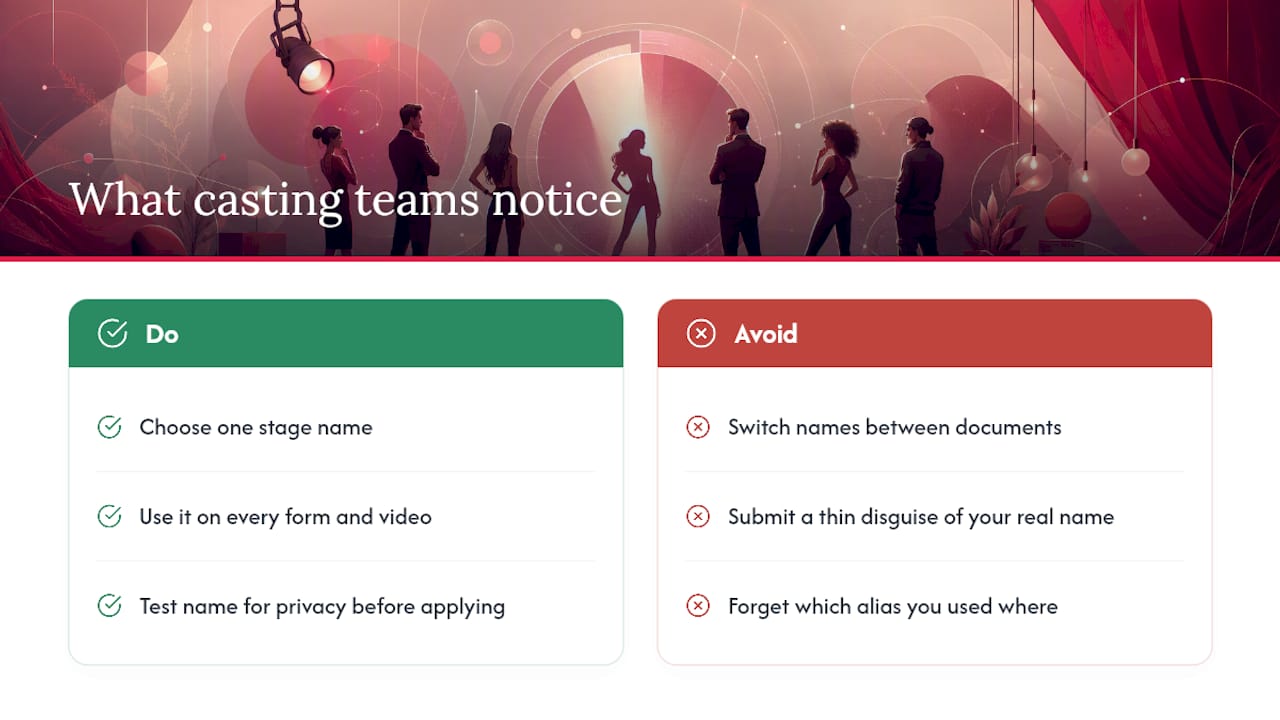
Casting teams see the same mistakes over and over: applicants who switch names between forms, submit a stage name that's obviously a thin disguise of their real one, or forget which alias they used on which document. All of that slows a review down or raises unnecessary questions.
What works is boringly simple. Pick one stage name, use it consistently across every form and video, and make sure it's already passed your own privacy checks before you apply. Compliance staff record names for legal purposes, not to publish them, so there's no reason to hedge or submit something half-finished. Come to the application with a name you've already tested and committed to.
— Trent
Apply Through a Secure, Confidential Casting Process
Some casting agencies exist for exactly that moment: submitting your chosen stage name somewhere that handles it securely. Their applications may include personal details, government-issued ID verification, and a video audition, reviewed exclusively by authorized staff rather than sitting in unsecured inboxes.
Once you submit, your materials go through confidential review, and your stage name gets recorded the way compliance requires, documented for legal purposes, never published or shared beyond what's necessary for producers to evaluate your application. You don't need to guess whether a submission channel is secure or wonder who's looking at your ID. If you've already picked and tested your name using the steps above, the next move is straightforward: start your application with Seattlexxxcasting and get your name into a process built to keep it confidential from the first upload.
This article is general information, not a substitute for advice from a qualified lawyer. Consult a qualified legal professional about your own circumstances before acting on anything here.